
Welcome to The Crumb & Chaos
Welcome to The Crumb & Chaos. Pull up a stool, push the flour off the counter, and make yourself at home.
I am Liz. I bake sourdough in a kitchen that is rarely tidy, with one biological kid, two stepkids, a husband who runs a business with me, and a son with Childhood Apraxia of Speech who has very strong opinions about which loaves are toast-worthy. It is loud here. It is messy. There are usually socks on the floor and flour in places flour should not be. And somewhere in the middle of all of it, I bake bread.
This blog is the version of sourdough I wish I had found when I started. Not the perfect, pristine, magazine-shoot version. The version where the dough sometimes goes too long because someone needed a snack, where the kitchen scale ends up buried under a stack of permission slips, and where the loaf still somehow turns out beautiful.
How This Whole Thing Started
Like a lot of sourdough stories, mine began with a glass jar of someone else’s starter. I picked it up from a stranger on a Buy Nothing group here in Gilbert, Arizona, brought it home, named it, and proceeded to nearly kill it three times in the first month.
I forgot to feed it. I left it on the counter when it should have been in the fridge. I left it in the fridge when it should have been on the counter. I once mistook it for leftover pancake batter and almost cooked it. Somehow it survived anyway.
The first loaf I made was a brick. Dense, gummy in the middle, a crust so hard I could have used it as a weapon. The second loaf was somehow worse. The third one accidentally turned out beautiful, and I have been chasing that loaf ever since. By the fifth or sixth bake, I stopped trying to force the dough through whatever schedule I had planned and started paying attention to what the dough actually wanted instead. Things got easier from there.
Why Most Sourdough Content Did Not Work For Me
I read every recipe. I watched every video. I followed every Instagram baker. And what I quickly figured out is that most of the content out there assumes you have an unlimited amount of free time, a perfectly climate-controlled kitchen, and a baker’s intuition you have not been allowed to develop yet. The recipes were mostly written by people who had already mastered sourdough, looking back at the journey through rose-tinted, well-lit, professionally-photographed glasses.
There is nothing wrong with that content. I learned a lot from it. But there is also a need for the other kind. The “I made this in a hot Arizona kitchen between school pickup and dinner” kind. The “my starter doubled while I was at the grocery store and I just had to wing it” kind. The “this loaf is ugly but my family does not care because it is still warm” kind.
So this is that. A blog for the rest of us. The home bakers making sourdough between school runs, work calls, and the daily small chaos of real family life.
What You Will Find Here
I am going to write about what I actually do in my kitchen. Not what looks the most photogenic, not what would win an Instagram contest, just what works in real life.
- Starter Tips — how to make one, feed one, troubleshoot one, and keep it alive through real life
- Beginner Loaves — easy, forgiving recipes you can actually fit into a busy day
- Discard Recipes — nothing goes to waste, and discard makes some genuinely incredible pancakes
- Bread Fails & Fixes — the troubleshooting guides I wish I had when I started
- Product Reviews — honest takes on the bakeware, tools, and ingredients I actually use
A Few Promises
I am going to keep this short, but these matter to me:
Real recipes only. If I publish it, I have made it. Many, many times. Probably while distracted. If a recipe shows up here, it has survived multiple attempts in my kitchen across different weather, different starter conditions, and different levels of background chaos.
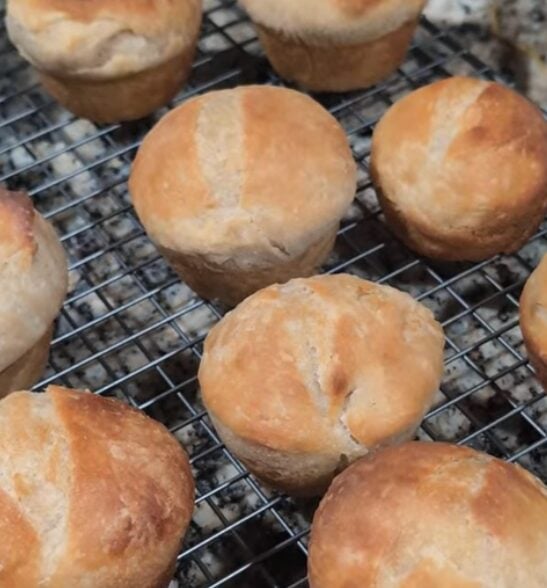
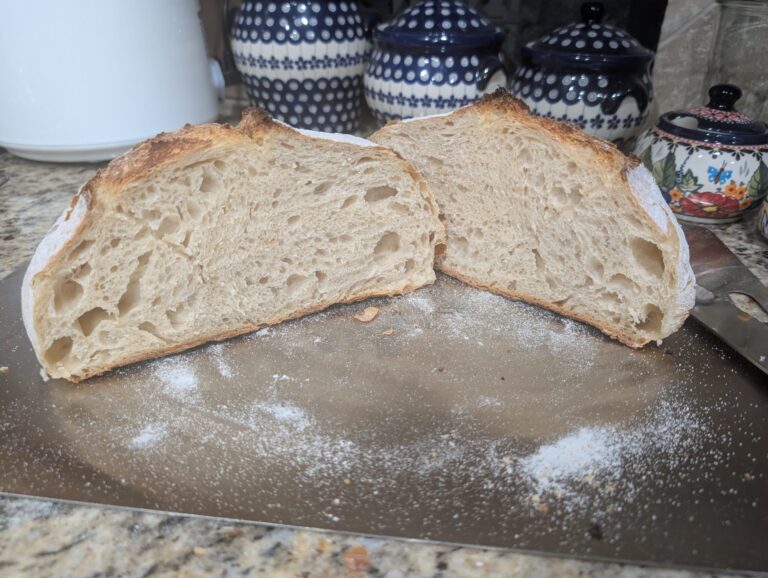
Real photos only. No stock images of someone else’s bread. The loaves you see here came out of my actual oven, in my actual kitchen, sometimes a little wonky. Sometimes the crumb is uneven, sometimes the crust is darker on one side. That is what real homemade bread looks like, and I am not going to pretend otherwise.
Honest recommendations. If I link to a product, I use it. If I would not recommend it to my sister-in-law, I will not recommend it to you. You can read my full affiliate disclosure here.
No fake intimacy. I am not going to write 800 words about my grandmother’s recipe to bury the actual instructions. Click into a recipe post and the first useful thing on the page is the recipe itself. The story comes later, for anyone who wants it.
Honest about the chaos. Some days the bread is gorgeous and the kitchen is spotless and I feel like Ina Garten. Some days the dough is overproofed because I forgot about it for six hours, and dinner ends up being scrambled eggs and toast made from the not-quite-right loaf. Both days are part of this.
Where to Start
If you have never made sourdough before, head to my Simple Everyday Sourdough Bread recipe. It is the loaf I bake on rotation, the one my family asks for by name, and the easiest place to start. The recipe is written for a real-life kitchen, with flexibility built in for when life happens.
If you want to know more about who I am and how this blog came together, my About page has the longer story.
And if you have a question, a sourdough disaster, a recipe request, or just want to say hi, the contact page is open. I read everything that comes in, even if it takes me a few days to write back. (See: chaos.)
One Last Thing
If you have been thinking about making sourdough but have been intimidated by all the precision and rules, I want you to know: it is so much simpler than the internet makes it look. You will mess up your first loaf. Probably your second. Maybe your tenth. And that is fine, because every “mistake” is teaching you what the dough actually wants. The bakers you admire on Instagram all started exactly where you are. They just kept showing up.
So feed your starter, mix something up, and see what happens. The worst case is a dense loaf and a story to tell.
Thanks for being here. Now go feed your starter.
— Liz